Keeping busy as a response to grief
Remarkably Bright CreaturesKeeping busy as a response to grief is a pattern in Tova Sullivan’s life, not a cure for loss. Nightly work gives her days a dependable shape and something to do, even as familiar places and routines keep the absence of her son, Erik, in view. The work offers movement and purpose; it cannot make her believe that Erik simply ran away or erase the questions his disappearance left behind.
Work as a Daily Structure
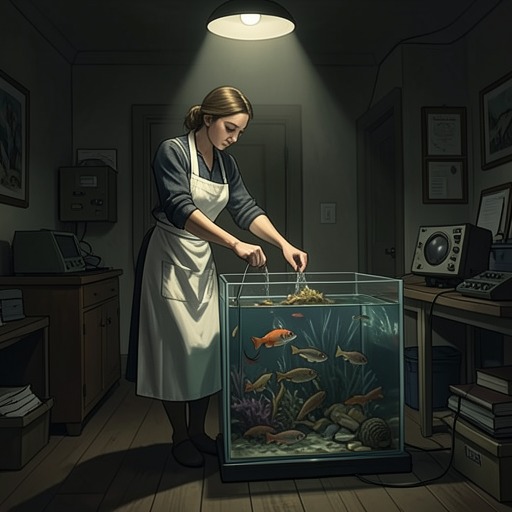
At seventy, Tova is the oldest employee at the Sowell Bay Aquarium. Each night she mops floors, wipes glass, and empties bins; every two weeks, she collects a pay stub for fourteen dollars an hour, with the money accumulating in an account. Her labor is modest and repetitive, but its continuity matters. When she spots gum on the floor, she considers fetching a file because the tools on her cart will not remove it. Her back pops as she heads to the supply closet, and she knows nobody would blame her for mopping around the mess. Still, she must at least try. The impulse is practical, but the act also supplies an immediate task: as the narration puts it, it is something to do.
That phrase describes more than a way to pass time. Tova’s work turns attention toward the next concrete obligation, whether the gum in the hallway or the residue around a tank. In the aquarium’s dim corridors, her routine continues after the cleaning is done: she makes a final round to say good night to the animals. The ritual places a gentle cadence around the close of her shift. It is another form of purposeful attention, sustained through repetition rather than a declaration that grief has ended.
Memory Inside the Routine
The aquarium’s objects and inhabitants also make Tova’s routine a route through memory. In an alcove, she passes a bronze sea lion whose back and bald head have been smoothed by generations of children. At home, a photograph shows Erik at about eleven or twelve, grinning as he straddles the statue with one hand raised like a sea cowboy. Tova keeps his photographs in chronological order, from babyhood to adolescence: his letter jacket, a corsage for a homecoming date, and a regatta trophy held on the rocky shores of Puget Sound waters. The sea lion’s cold head brings her close to that carefully preserved sequence, and she has to quiet the recurring question of what Erik might look like now.
Her final aquarium rounds extend this attentive habit to the animals themselves. She bids the bluegills, Japanese crabs, seahorses, sea cucumbers, sharks, and others good night. The sharks, circling without a pause, draw particular sympathy: Tova understands what it means never to stop moving for fear of being unable to breathe. That comparison gives her busyness an ambivalent edge. Movement sustains her, but it also resembles confinement when stopping seems impossible. The routine can comfort and expose the cost of carrying on at the same time.
Grief Kept Private
Tova’s friends, the Knit-Wits, began as a knitting club and became a refuge for women living with the empty homes left by children who had grown up and moved away. Tova initially resisted joining. Their absence was bittersweet; hers, after Erik disappeared, held no sweetness. When the group’s conversation turns to children and grandchildren, she experiences motherhood as something kept inward and private, rather than worn openly as the other women wear theirs. Being among friends does not make her loss easy to share. At times she feels like a misplaced piece in their social circle, even after years of friendship.
Her disbelief in the runaway explanation is part of what remains unspoken. Erik had been due to lock up the ticket booth after his summer job at the ferry dock. The last person reported to have seen him was a deckhand on the eleven-o’clock southbound ferry. The booth was found unlocked, but its register cash was accounted for; Erik’s backpack, cassette player, headphones, and wallet were left beneath a chair. Authorities initially treated the disappearance as a possible runaway case, yet Tova never believed he had simply gone away. Her everyday tasks do not resolve that conviction. They let life proceed alongside a question she has not set aside.
Labor, Loss, and Care
Tova also measures her way of coping against Will’s response to Erik’s absence. Before the disappearance, Will and Erik would lounge together watching whatever sport was in season. Tova cleaned around them, vacuuming potato-chip crumbs from the sofa and wiping soda-can rings from the coffee table. After Erik was gone, Will continued sitting on the same cushion while Erik’s place stayed empty. His repeated stillness irritated Tova; she concludes that keeping busy is healthier. Her own preference for activity thus appears not only as a habit, but as a contrast between two ways of enduring the altered household.
That belief surfaces directly when Tova recalls insisting that Erik take a summer job. She says any reasonable parent would have required it, then falters over the thought that she could not have known what would happen. Without pausing to dwell on the memory, she reaches for the rag in her apron and scrubs calcification from a tank’s rubberized rim. The residue is stubborn but eventually gives way. Meanwhile, Marcellus holds onto her arm, watching as she cleans. The moment joins recollection to present care: Tova’s hand finds work even while her words approach regret. When she stretches toward a distant part of the rim, the stool wobbles and she falls onto the tile.
The episode does not present busyness as a simple victory over grief. Tova’s labor preserves routine, directs care outward, and gives her a way to continue without forcing private sorrow into conversation. Yet her repeated cleaning cannot change the facts she carries, and the effort has limits: a difficult task can turn physically dangerous when she reaches too far. The pattern’s significance lies in that tension. Work gives Tova a way forward through ordinary hours, while the photographs, the empty place beside Will, and the unanswered disappearance remain part of the life she is moving through.